Key Takeaways
- AI can identify qualified candidates faster than ever, but qualifications have never been the hardest part of hiring.
- The qualities that make someone a great teammate, including judgment, curiosity, ownership, and adaptability, are still deeply human.
- Remote-first companies are shifting from hiring for today's technical skills to hiring for long-term learning potential.
- AI can improve onboarding by removing repetitive work, giving managers more time to build relationships with new hires.
- Great hiring has never been about filling a role. It's about finding people who will help the team become better over time.
Every hiring manager is, at heart, trying to predict the future. Think about the last person you brought onto your team. You weren't simply trying to fill an open role. You were trying to answer something harder, something no job description actually captures.
Will this person make our team better?
Not just this quarter, but six months from now, maybe three years from now, when the role looks different and the team has changed around them. That uncertainty has always been the real challenge of hiring, and it hasn't gotten easier.
A résumé tells you where someone has worked. An interview gives you a glimpse of how they communicate under structured conditions. References offer a window into what they were like somewhere else, in a different context, with different people. But none of those things can tell you what every leader is really asking.
What will this person be like once they're part of our team?
Artificial intelligence promises to make hiring smarter. It can scan thousands of applications in minutes, summarize interview notes, compare qualifications, and recommend candidates based on patterns from previous hiring decisions. For recruiters and hiring managers, those capabilities are genuinely useful. Nobody enjoys spending hours manually reviewing résumés or coordinating interview schedules. But after listening to leaders throughout Running Remote 2026, one thought kept coming back to me.
AI isn't solving the hardest part of hiring.
It's solving the logistics. Finding qualified candidates has never been the biggest challenge. Recognizing the people who will become trusted teammates has always been much harder, and that's a problem no algorithm can solve on its own.
As AI gets better at evaluating experience, organizations are discovering that the qualities they value most are also the ones technology struggles to measure, including curiosity, judgment, ownership, adaptability, and the willingness to keep learning even after someone has mastered today's tools. Those qualities aren't listed on a résumé. They're revealed over time, through conversations, decisions, and how people respond when the work becomes uncertain. If anything, AI is reminding us what great hiring has always been about.
AI Can Evaluate Experience. Leadership Evaluates Potential.
One of the biggest misconceptions about AI hiring is that recruitment is simply a matching exercise. A company publishes a job description, candidates submit their résumés, and AI compares qualifications against the role to identify the strongest matches. From a logistical perspective, that's genuinely helpful. Recruiters spend less time sorting through hundreds of applications and more time speaking with promising candidates, and the administrative overhead that used to eat entire afternoons begins to disappear.
Those are meaningful improvements. But hiring has never been difficult because of paperwork. It's difficult because résumés only tell part of the story.
Two candidates can have nearly identical experience, similar accomplishments, and the same technical skills, and on paper they may look equally qualified. Six months later, however, their impact on the team can be completely different.
One becomes the person colleagues naturally turn to when problems arise. The other quietly struggles to adapt. What changed between the interview and that six-month mark is rarely technical ability.
It's everything the résumé couldn't show in the first place, including how someone approaches uncertainty, how they respond when they don't know the answer, whether they take ownership when something goes wrong, and whether they're willing to keep learning instead of relying on what they already know. Those qualities have always mattered. AI simply reminds us how difficult they are to measure.
The Skills That Matter Most Are Becoming More Human
Throughout Running Remote 2026, I noticed something worth paying attention to. Very few speakers spent much time discussing which AI tools candidates should know. The conversation kept returning instead to how people think. Not what they know, but how they reason when the answer isn't obvious.
Mike Melen from SmartSites made this point clearly in their Running Remote session on the future of remote teams. Although technology changes constantly, the qualities he looks for in interviews haven't changed nearly as much. Technical knowledge evolves, but reasoning doesn't. He still wants to understand how candidates approach unfamiliar problems, how they think through uncertainty, and whether they can exercise sound judgment when there isn't an obvious answer.
That observation stuck with me because it cuts against the instinct to treat AI proficiency as a primary hiring signal. For years, expertise meant having the right answer. Today, AI can generate dozens of possible answers within seconds, which shifts the value somewhere else entirely.
Anyone can ask AI to draft a proposal, summarize research, write code, or generate ideas. The harder and rarer skill is knowing when the output is incomplete, inaccurate, or simply not good enough. That takes judgment, and judgment remains stubbornly human.
As AI gets better at producing information, the people who stand out won't necessarily be those who know the most tools. They'll be the ones who consistently make better decisions with whatever tools they have.
Companies Are Looking for Learners, Not Experts
Another idea that surfaced repeatedly throughout the conference was the importance of learning, not formal training or certifications, but learning as an ongoing disposition rather than a credential to collect.
In her Running Remote session on the evolving remote employee journey, Tracy St.Dic from Zapier described how hiring conversations increasingly focus on understanding how candidates approach unfamiliar situations, whether they're naturally curious, and how they continue developing after they're hired. Rather than trying to identify someone who already knows every AI platform, they're looking for people who demonstrate the capacity to keep learning as technology evolves.
The logic holds up when you consider how quickly the tools actually change. The AI platform someone masters today may look completely different a year from now, as new capabilities appear, workflows shift, and expectations evolve alongside them. Hiring for today's expertise is essentially a bet that tomorrow will look the same, and that bet has rarely paid off in technology.
What tends to age better is curiosity. Curious people don't wait to be retrained on the next thing. They explore it, ask questions about it, and figure it out faster than someone who is waiting for their current expertise to transfer. In a workplace where change is accelerating rather than leveling off, the willingness to keep learning may be one of the most durable qualities an organization can hire for.
From Executors to Builders
Perhaps the most thought-provoking moment at Running Remote wasn't about AI itself. A Running Remote session on the rise of the remote autonomous professional described a shift that stayed with me. Organizations are no longer just asking whether someone can follow an existing process. They're asking whether someone can help design a better one.
That distinction is easy to understate. Execution will always matter, and every organization needs people who can deliver consistent, reliable work. But AI is changing what execution looks like. Routine tasks are becoming easier, documentation can be drafted in minutes, research starts faster, and the administrative layer that used to consume significant chunks of people's days becomes increasingly automated. When execution gets more efficient, the competitive advantage moves somewhere else.
It moves toward the people who ask the questions nobody else thought to ask, who simplify processes that everyone else accepted as fixed, who make the people around them more effective without being told to. The session framed them as builders, and the word fits. Builders don't wait for permission to improve something. They notice friction and do something about it.
And the somewhat counterintuitive thing is that AI makes those people more valuable rather than less, because as the repetitive work clears away, the organizations left standing are the ones with people who know how to do something meaningful with the space that opens up.
Hiring the Right Person Is Only Half the Job
Imagine AI does everything it's supposed to do. It helps you source candidates faster, summarizes interviews, surfaces the strongest applicants, and maybe even improves the final hiring decision. You've found the right person. The offer is signed. Now the real challenge begins.
The new hire still has to succeed, and that part of the process rarely gets enough attention. A great candidate can become a disappointing hire when they're dropped into an unfamiliar environment without the context and support they need to find their footing. Tools like Icebreakerz exist specifically to close that gap, giving new hires structured, low-stakes ways to connect with teammates before the work gets overwhelming.
Conversely, someone who seemed merely "good" during interviews can grow into one of your strongest team members when they're given the right relationships, guidance, and room to develop. The hiring decision matters, but the experience that follows it matters at least as much, and it's in that space where AI is beginning to create some of its most practical value.
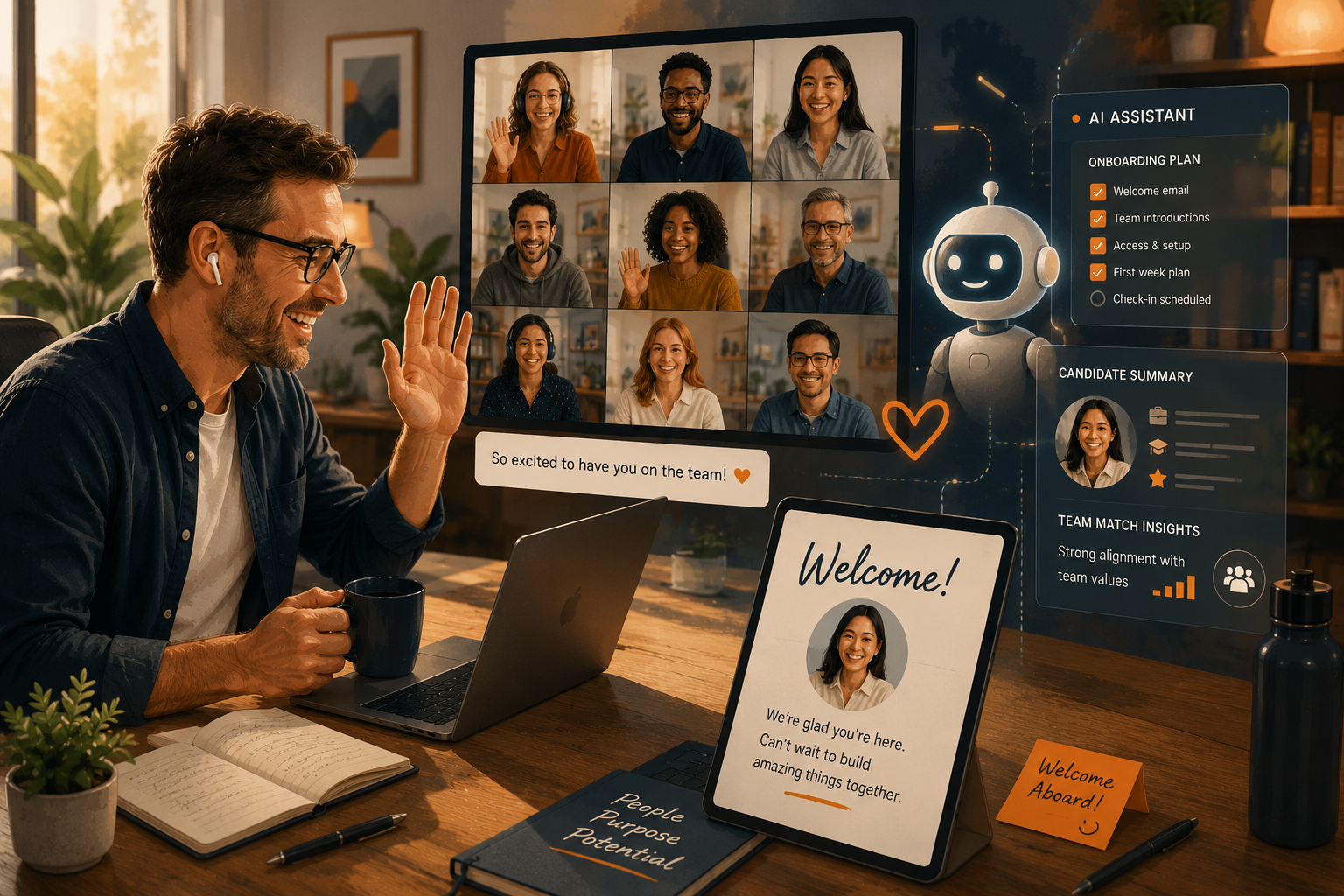
AI Can Make Onboarding Feel More Human
One of my favorite examples from Running Remote came from Beth White, CEO of MeBeBot, presenting alongside Mike Melen in their session on the future of remote teams. Rather than using AI to replace managers or automate the entire onboarding experience, her team focused on something more targeted. They used AI to absorb the small, repetitive questions that pile up for every new employee in the opening weeks on the job.
Every new hire has questions. Lots of them.
"Where can I find this document?"
"Who owns this project?"
"What does this acronym mean?"
"Is this the latest version?"
They're perfectly reasonable questions, and also the kinds of questions people often hesitate to ask out loud. Nobody wants to feel like they're interrupting a colleague every fifteen minutes, and nobody wants to be the person asking something everyone else already seems to know. That hesitation is quiet but costly. It slows down the new hire's ability to contribute and chips away at their confidence during exactly the period when confidence matters most.
Beth described how AI became a safe place for those questions. New employees could ask freely, get immediate answers, and build their understanding without the social cost of interrupting someone.
Rather than replacing conversations with managers, it removed the repetitive logistical questions that used to consume those conversations, which freed managers to spend their time on the things only a human does well, including helping someone understand the team's goals, navigate a difficult situation, and feel like they genuinely belonged. The technology wasn't making onboarding less personal. It was making room for the parts of onboarding that actually matter, including the virtual icebreakers and structured check-ins that help new hires build real familiarity before the formal structure runs out.
The Best Companies Aren't Choosing Between AI and People
There's a tendency to frame every conversation about AI as a binary, and it tends to be the biggest mistake companies make when adopting it. Either technology replaces people, or people push back and resist it. The conversations at Running Remote felt different from that framing.
Nobody at the conference was arguing for less human leadership. If anything, the organizations embracing AI most successfully were arguing for more of it, because they'd figured something out.
They weren't using AI to remove people from the equation. They were using it to remove the work that kept people from doing their best, letting AI handle the repetitive tasks and the information management while people stayed focused on judgment, trust, and the kind of relationship-building that keeps remote teams from feeling transactional. That division of labor isn't a compromise. It's a better version of how knowledge work was always supposed to function.
The goal has never been to automate human connection. The goal is to create more room for it.
Your Next Great Hire Won't Be the One With the Best Prompt
It's tempting to think AI changes everything about hiring, and in some ways it does. It changes the speed, the logistics, the volume of candidates a team can realistically consider. But after spending time with leaders throughout Running Remote 2026, I came away thinking the more important things haven't changed at all.
Companies aren't hiring résumés. They're hiring people, specifically people who can work through problems that don't have obvious answers, who continue learning after the interview is over, who make their teammates better, and who help build a culture worth working in. Those qualities were valuable before AI and they're valuable now. What AI does, at its best, is clear away enough of the noise to make them easier to see.
That may be the most useful reframe to take from Running Remote. The future doesn't belong to the organizations with the most AI. It belongs to the organizations that get better at recognizing human potential and then creating the conditions where that potential actually develops. AI can tell you who's qualified. Leadership is still what tells you who's going to become a great teammate.
Frequently Asked Questions
Can AI replace human judgment in hiring?
Not for the parts that matter most. AI hiring tools can screen candidates faster, compare qualifications, and surface strong applicants. But the qualities that make someone a great teammate, including curiosity, judgment, and the ability to keep learning, are still very difficult for technology to measure. AI improves the logistics of hiring. It doesn't replace the human decision at the center of it.
What should companies look for when hiring in the age of AI?
The qualities that matter most are shifting away from specific tool knowledge toward how people think and learn. Hiring managers are increasingly focused on how candidates approach unfamiliar problems, whether they exercise sound judgment when there isn't an obvious answer, and whether they'll keep developing after the interview is over. Technical skills matter, but they have a shorter shelf life than curiosity and adaptability.
What is the difference between hiring executors and hiring builders?
Executors follow existing processes reliably. Builders actively improve how work gets done. As AI takes over more routine tasks, the competitive advantage shifts toward people who notice friction, ask better questions, and find better ways of working without being told to. Both matter, but AI is making builders disproportionately more valuable.
How can AI improve remote onboarding without making it feel less human?
The most effective approach is using AI to handle the small, repetitive questions every new hire has, so managers have more time for the conversations that actually build relationships. When new employees can get immediate answers on logistics and documentation, they arrive at 1:1s ready to talk about goals, context, and culture rather than where to find the right folder.
Why does curiosity matter more than AI expertise when hiring?
AI tools change constantly. Someone who is an expert in today's platforms may be working with entirely different tools a year from now. Curiosity is the quality that lets someone adapt when that happens. Curious people don't wait to be trained on the next thing. They explore it, ask questions about it, and figure it out faster than people who are waiting for expertise to transfer.
Related Reading
- The Biggest Mistake Companies Make When Adopting AI
- Virtual Icebreakers for Remote Onboarding
- Why Remote Teams Feel More Transactional Than They Used To
Sources
- Your Remote Team in 2027: Fewer People, More Output, Different Skills — Mike Melen (SmartSites) & Beth White (MeBeBot)
- The Evolving Remote Employee Journey: Where AI Meets the Human Experience — Tracy St.Dic (Zapier)
- The Rise of the Remote Autonomous Professional: AI and the Builder Mindset
Help Your New Hires Actually Feel Like Part of the Team
Hiring the right person is only the beginning. The first few weeks determine whether someone thrives or quietly pulls back. Icebreakerz gives teams a low-stakes way to actually get to know each other, so new hires spend less time feeling like outsiders and more time becoming the teammate you hired them to be.
Try Icebreakerz