Key Takeaways
- Most all-hands meetings fail at the engagement layer, not the agenda layer
- A single 15-minute interactive segment can shift the energy of the entire meeting
- The best virtual team engagement activities are low-stakes, timed, and require zero prep from participants
- Adding one structured engagement touchpoint before your main agenda is the fastest way to improve participation across the whole call
- Quick Quiz is built specifically for this: live rounds, real-time scoring, no setup
Most remote teams discover the value of virtual team engagement activities the same way: by running an all-hands that lost the room before the second agenda item. The content was solid, but the format didn't require anyone to actually engage.
Why most all-hands meetings lose the room early
The format is almost always the same. Someone shares a company update, then another person does the same, and then there's a Q&A that doesn't really go anywhere. Then everyone drops off feeling like they could have read an email.
The problem isn't the content. It's that nothing in that format requires anyone to actually show up mentally. You can attend on mute, half-reading Slack, and miss nothing you couldn't catch in the recap — and a lot of people figure that out pretty quickly.
Passive formats produce passive attendees. Microsoft's 2022 Work Trend Index found that 43% of remote employees and 44% of hybrid employees don't feel included in meetings, a number that maps directly to how most all-hands are structured. Gallup puts global employee engagement at around 20%. All-hands meetings built around one-way information delivery do nothing to change either number, and in most cases just confirm where things already stood.
The engagement problem in all-hands is a format problem, not a technology problem or a preparation problem.
What actually creates engagement in a remote meeting
The moments people remember from a good meeting are almost never the slides. They're more likely the moment someone said something surprising in the chat, or the quick round of questions where people had to actually think, or whatever that one exchange was that felt a little different from how meetings usually go.
All of those moments required something from the people in the room: not passive listening, but responding, deciding, or engaging with each other in real time.
Virtual team engagement activities work on this principle. They introduce a low-stakes interaction that activates the part of the brain that goes dormant during a passive presentation. And that activation tends to carry forward into the rest of the meeting.
When you give people a reason to engage early in a meeting, they stay engaged longer. Most all-hands formats put the engagement moment at the end, in a Q&A that rarely gets traction, rather than at the start, where it can change the tone of everything that follows.
The 15-minute format that actually works
The format is simple. Before the main agenda, or as an early segment, you run a short interactive game. It has a structure, a time limit, and a clear ending. You're not asking anyone to come up with something personal on the spot, and the game doesn't need someone to be chatty to keep it moving.
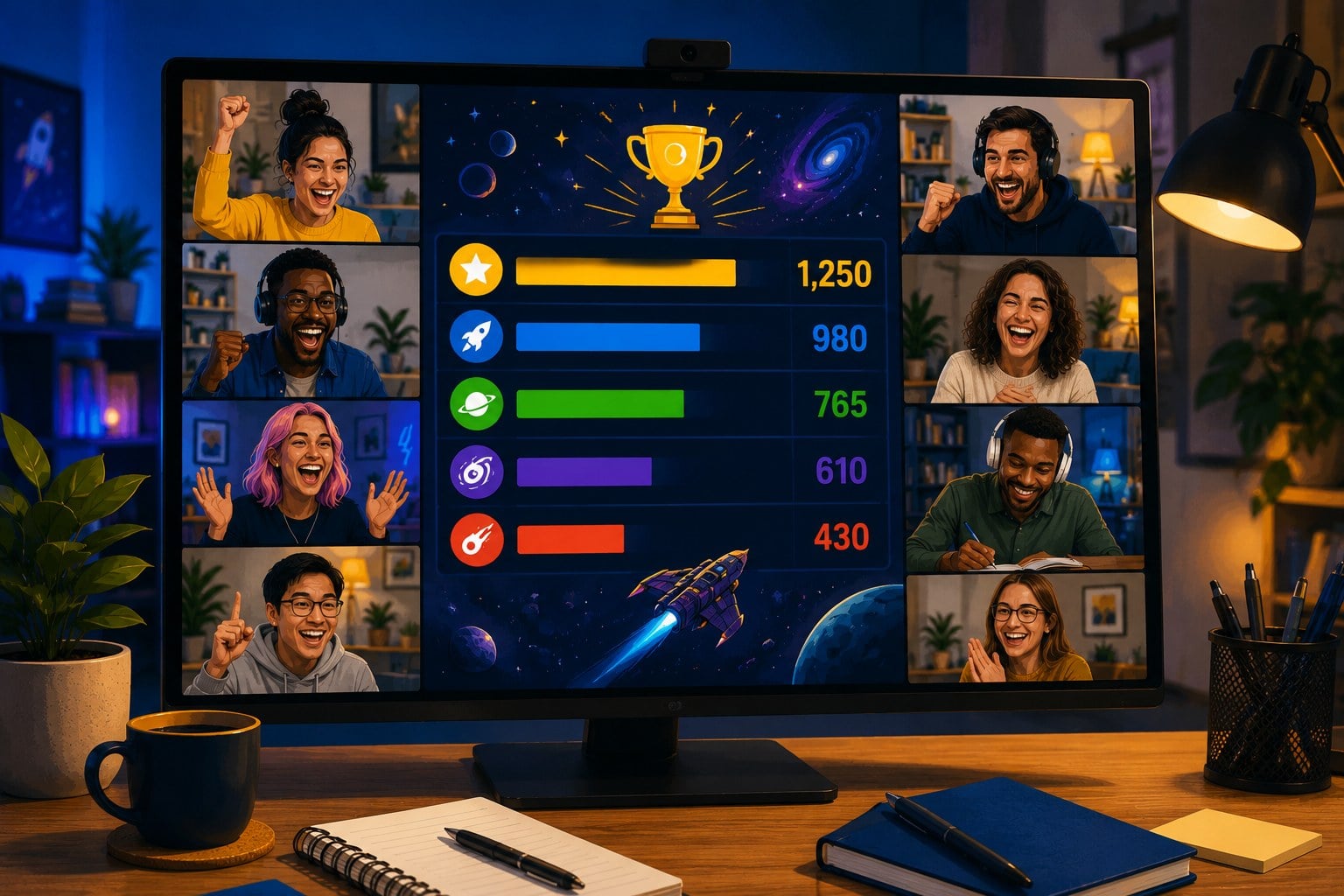
Quick Quiz is built specifically for this use case. It runs in the browser, works without downloads or accounts for participants, and is designed to be run live in a meeting. A host launches a round, participants join on their own devices, and the game runs for 10 to 15 minutes. It's scored, competitive in a low-stakes way, and requires no preparation from anyone except the person running it.
What that format does for an all-hands is create an unguarded moment. People are reacting to questions, competing, laughing at the leaderboard. They're not performing attentiveness or waiting for the slide to change. And when the game ends and the meeting proper begins, the energy in the room is different from how it started.
How to introduce it without making it feel forced
The biggest hesitation most managers have about adding games to an all-hands is that it will feel out of place, or that the team will roll their eyes at a mandatory fun moment.
The way to avoid that is framing and scale. You're not announcing a new culture initiative. You're opening the meeting differently. "Before we get into updates, we're doing 10 minutes of Quick Quiz. No prep needed, just join on your phone or second screen."
Keep it short. The first time, do one round, end it before it runs out of energy, and move on. Let people comment in the chat. If the team is skeptical, the only thing that will change that is doing it once and having it land well. Overselling it beforehand makes it worse.
The other thing that helps is making it a consistent feature rather than a one-off. The first time is the awkward time. By the third time, people expect it, some of them look forward to it, and the moment of activation it creates becomes a reliable part of how your all-hands works.
What changes after you make this a habit
The most consistent thing you'll notice after adding a structured engagement touchpoint to your all-hands is not that the game becomes beloved. It's that participation in the rest of the meeting improves.
People who were previously on mute and half-present are more likely to speak up during Q&A. The chat stays more active, and the energy from the opening tends to carry further into the agenda than you'd expect.
Part of that is the warm-up effect. You've activated the social layer of the meeting early, and it carries forward. Part of it is the signal the format sends — when you open with something interactive, you're telling people that attendance means something more than showing up on camera. Most people respond to that, even if they'd never say so out loud.
It's 15 minutes off the agenda. What that usually buys you is a room that's more awake for the rest of it.
FAQ
What are virtual team engagement activities?
Virtual team engagement activities are structured interactions designed to increase active participation in remote team meetings. They range from icebreaker questions to live competitive games. The most effective versions are short, low-stakes, and don't require advance preparation from participants.
How do you make an all-hands meeting more engaging?
The most reliable approach is to add an interactive segment early in the meeting rather than relying on a Q&A at the end. A 10 to 15-minute game or structured activity creates an unguarded moment of participation that tends to carry forward into the rest of the meeting.
What is Quick Quiz and how does it work for all-hands?
Quick Quiz is a live, browser-based trivia game designed for remote teams. A host launches a session, participants join on their own devices, and the game runs in real time with scoring and live results. It's designed for meeting contexts and requires no downloads or setup from participants.
How often should you run engagement activities in all-hands?
Every time is better than occasionally. The teams that see the most benefit treat it as a consistent feature of the format rather than a special event. Consistency removes the awkwardness and turns it into something people expect and often look forward to.
What if my team is resistant to games in meetings?
Keep it short, don't oversell it, and let the experience do the work. The first round is always the awkward one. Most resistance dissolves once people have actually played and it landed better than they expected. Framing matters: you're opening the meeting differently, not launching a team-building initiative.
Sources
- Microsoft. (2022). Work Trend Index Annual Report.
- Gallup. (2023). State of the Global Workplace Report.
Try Quick Quiz at Your Next All-Hands.
Launch a live quiz round in under a minute — no downloads, no setup for participants. Add it to the front of your agenda and the energy carries forward into everything else.
Try Quick Quiz Free